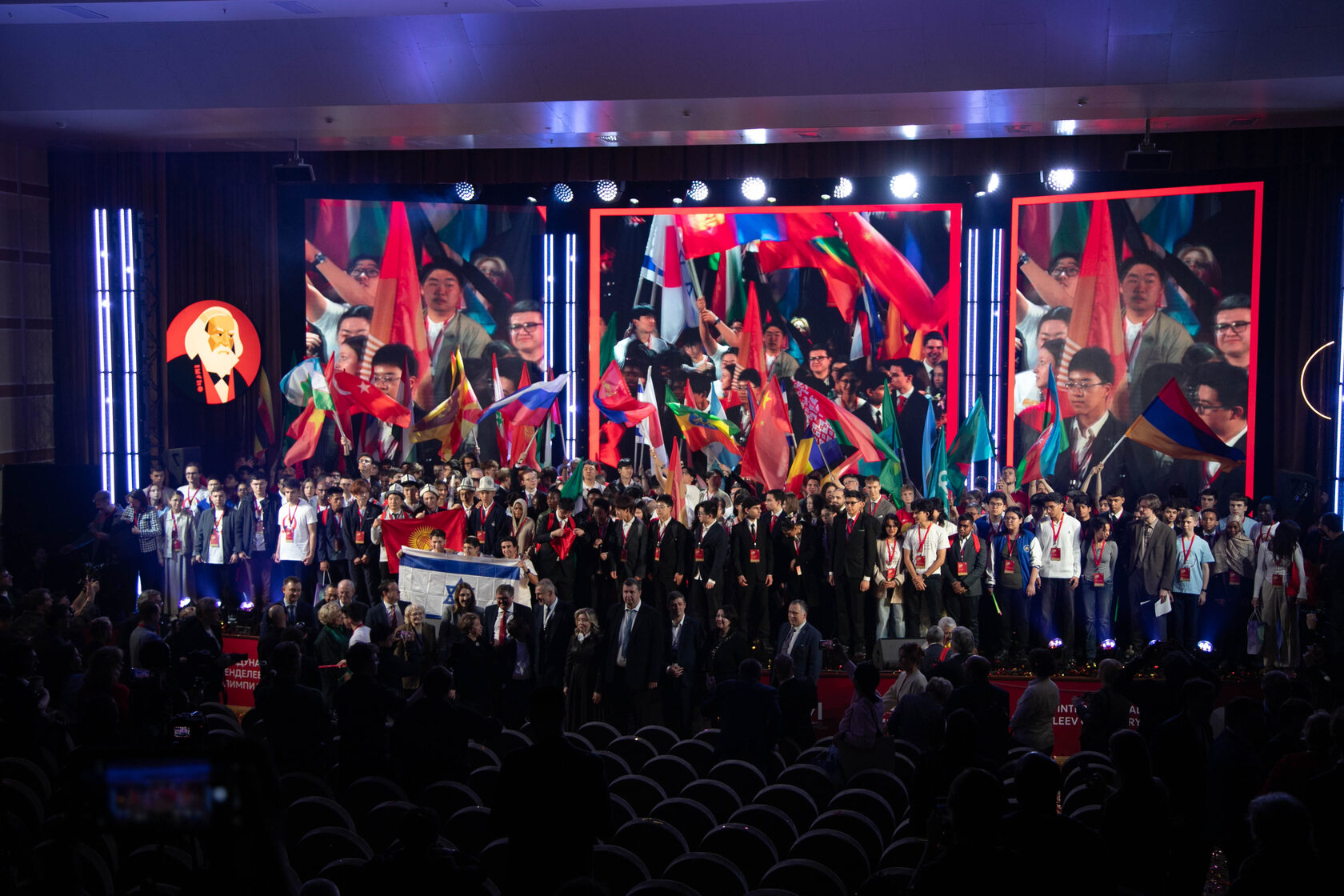
Following the results of the 60th International Mendeleev Olympiad of Schoolchildren in Chemistry, held in Moscow from April 15 to 23, 2026, a comprehensive calculation of the carbon footprint of the event was carried out and its full compensation was ensured.
Thus, the Olympiad, organized by the Chemistry Faculty of Moscow State University and the Melnichenko Foundation, received the status of a carbon-neutral event for the first time in its history. The calculation of the carbon footprint was carried out in accordance with the international GHG Protocol standard, taking into account emissions of the Scope 3 category, including the most significant sources. In particular, the assessment takes into account participants' air travel, ground transportation, accommodation, as well as the use of various products necessary for organizing the competition.
The total amount of compensation will be about 180 tons of CO₂ equivalent. The largest contribution was made by air travel of the participants. The refund will be made by writing off carbon units received from the implementation of climate projects by the Melnichenko Foundation’s partner, the Siberian Generating Company (SGC), which has upgraded heat supply systems in the Krasnoyarsk Territory, Kemerovo and Novosibirsk regions. In May, the Olympic footprint was calculated on the platform of the national registry of carbon units.
Tatiana Zhuravleva, General Director of the Melnichenko Foundation, noted: "The transfer of the Mendeleev Olympiad to a carbon-neutral format is a contribution to the formation of a new professional mindset of future scientists. We are convinced that environmental issues and the rational use of resources should become an integral part of the scientific and educational environment."
The jubilee International Mendeleev Olympiad in Moscow brought together schoolchildren from 37 countries. All 15 members of the Russian national team won medals. 7 schoolchildren from Moscow, Samara, Magnitogorsk and the Moscow region won gold, and this is the best result among all participating countries in the gold competition. Eight more national team members from Moscow, Kazan, Sirius, Saransk, and St. Petersburg were awarded silver medals.
Thus, the Olympiad, organized by the Chemistry Faculty of Moscow State University and the Melnichenko Foundation, received the status of a carbon-neutral event for the first time in its history. The calculation of the carbon footprint was carried out in accordance with the international GHG Protocol standard, taking into account emissions of the Scope 3 category, including the most significant sources. In particular, the assessment takes into account participants' air travel, ground transportation, accommodation, as well as the use of various products necessary for organizing the competition.
The total amount of compensation will be about 180 tons of CO₂ equivalent. The largest contribution was made by air travel of the participants. The refund will be made by writing off carbon units received from the implementation of climate projects by the Melnichenko Foundation’s partner, the Siberian Generating Company (SGC), which has upgraded heat supply systems in the Krasnoyarsk Territory, Kemerovo and Novosibirsk regions. In May, the Olympic footprint was calculated on the platform of the national registry of carbon units.
Tatiana Zhuravleva, General Director of the Melnichenko Foundation, noted: "The transfer of the Mendeleev Olympiad to a carbon-neutral format is a contribution to the formation of a new professional mindset of future scientists. We are convinced that environmental issues and the rational use of resources should become an integral part of the scientific and educational environment."
The jubilee International Mendeleev Olympiad in Moscow brought together schoolchildren from 37 countries. All 15 members of the Russian national team won medals. 7 schoolchildren from Moscow, Samara, Magnitogorsk and the Moscow region won gold, and this is the best result among all participating countries in the gold competition. Eight more national team members from Moscow, Kazan, Sirius, Saransk, and St. Petersburg were awarded silver medals.